Followership Assessment Tool
The ultimate proof of leadership lies not in the actions of leaders but in what their followers actually do
There is no leadership without followership. Indeed, the ultimate proof of leadership lies not in the actions of leaders, but in what their followers actually do. As such, it is important to distinguish ‘leader’ from ‘leadership’. The former is a person and the second is an act. While not everyone can be a leader, everyone can demonstrate leadership. On the same token, everyone can (and ought to) demonstrate followership. An effective follower adopts a leader’s ideas as their own and applies critical thinking and effort to achieve it. It is an agentic action to achieve an outcome ideated by someone else. In this sense, followership is leadership and vice versa.
Ultimately, it is a collective act (by both leaders and followers) to get stuff done!

A follower is someone who makes rational choices about their behaviour (engagement and critical thinking) in response to leadership. As such, we can look to the behaviours of our followers to assess the effectiveness of our leadership.
Robert E Kelley created a framework of ‘follower types’ that reflected the level of a engagement and critical thinking exhibited by a follower. Kelley found that organisations need people who will both challenge and commit and so reflect the x-axis and y-axis of his framework. He considered high levels of critical thinking combined with high levels of engagement to be rare and required leaders to create conditions where both can occur.
As such, it is important to remember that follower types are not character flaws nor virtues. Rather they are a rational adaptation to environmental conditions. While leaders do not represent all environmental conditions (culture, resourcing, climate, etc) that shape followership, they still loom large in the formation of followership type.
Ultimately: •There are many things you cannot control, but you can control your leadership:
What are you doing or not doing that is contributing to followership in your world?
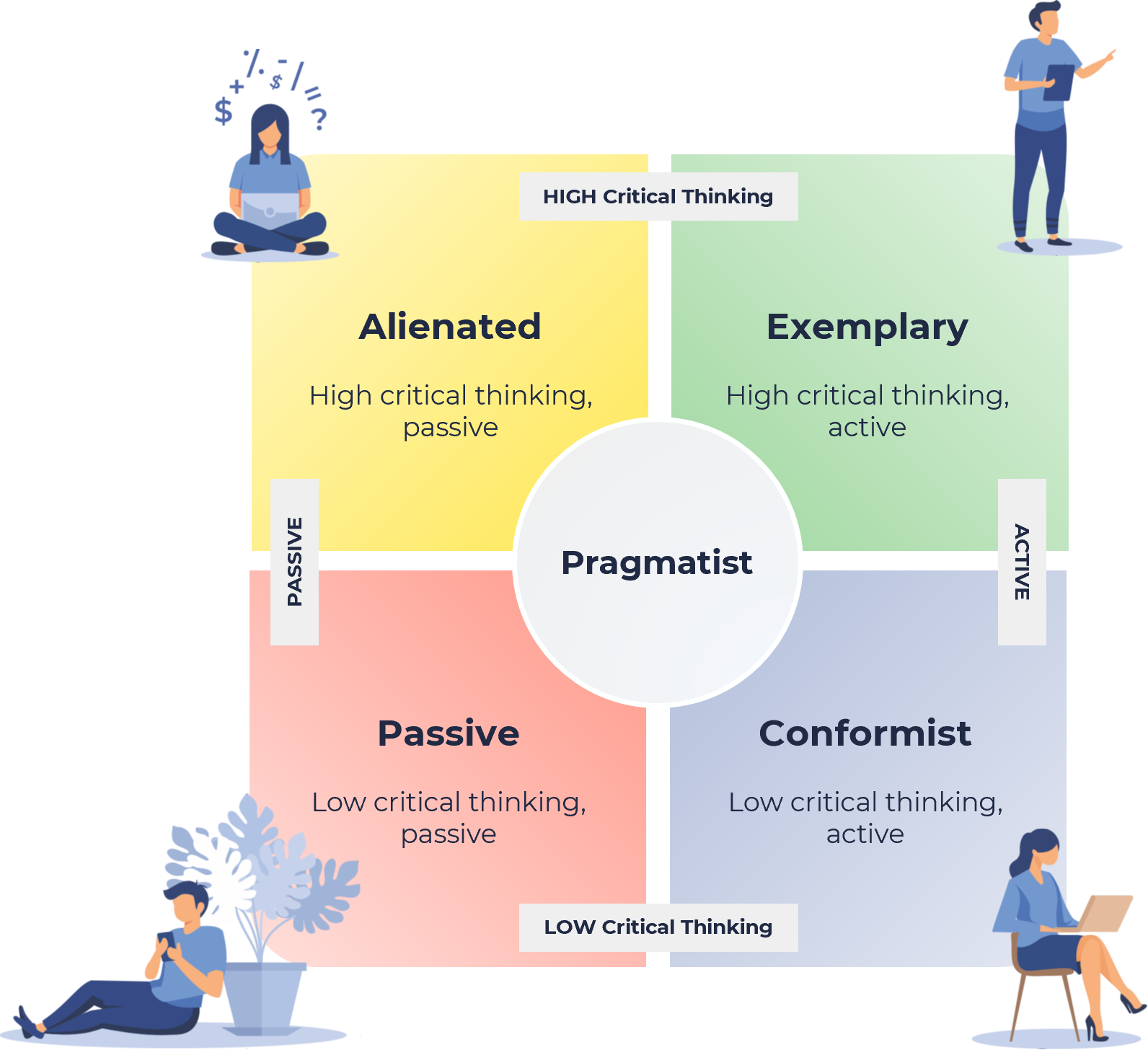
Kelley, R. (1992). The Power of Followership. New York, NY: Doubleday.
Use the tool below to consider what you can start doing (or stop doing) to get the followership you need
Inspiring Followership

Building effective leader/follower relationships
The best leaders are also the best followers. Leadership is an influence relationship between leaders and followers. Leaders need to be able to build productive relationships through transformational leadership to get the best out of their people.
As a result, leaders must be able to inspire team members to have the courage to accept responsibility, courage to serve, courage to question, the courage to be part of necessary change and the courage to take a moral stand where necessary.
This program looks at what an effective follower does and how the leader can influence effective follower behaviours.
In this program, participants will consider the way they communicate with their followers and build buy-in.
They will also consider how to empower their followers and encourage diversity of thought when dealing with the most complex problems.
-
As a result of attending this program, participants will:
Create an environment that encourages constructive, divergent views
Build higher levels of team potency
Apply transformational leadership to increase follower performance
Empower their followers to give input and take ownership of problems
-
Followership
Leader-Member Exchange (LMX)
Authenticity
Transformational Leadership
-
1-day F2F or abridged virtual workshop
Facilitator-led knowledge transfer
Small group and large group discussion
Who should attend?
This program is designed for more established managers who want to rely less on their positional authority and achieve greater influence through leadership.
Let’s Work Together