
When it’s Not Easy to Lead
Why discomfort matters for teams under pressure
The conventional wisdom about high-performing teams is that they are calm and free of friction. That intuition is almost exactly wrong. A team that experiences no discomfort is usually a team that has stopped paying attention to what is happening around it. Discomfort itself is not the problem. It is a signal from the operating environment that something important is happening. Rather than ignoring it or hoping it will go away, learning to recognise and embrace these signals is a core leadership skill. The absence of discomfort is not psychological safety. In reality, it is a lack of safety and a lack of engagement.
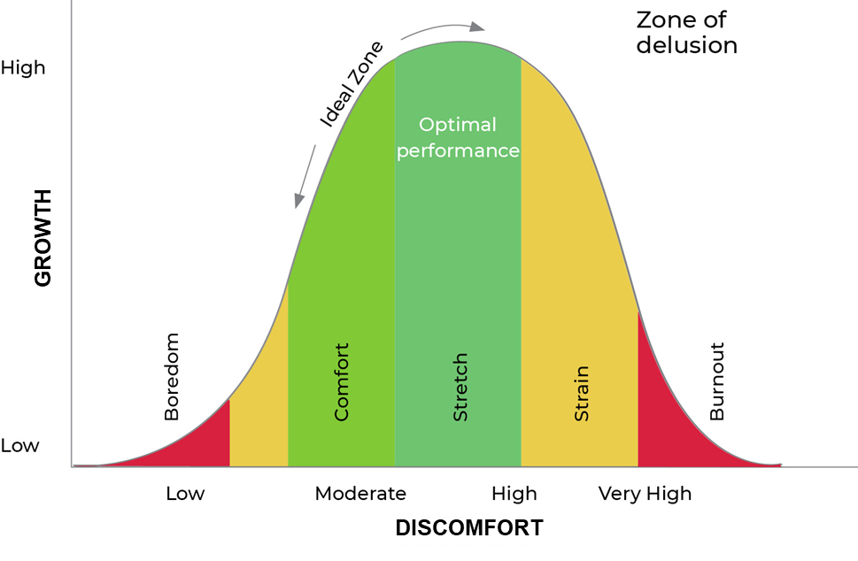
The Yerkes–Dodson curve, formulated more than a century ago and replicated many times since, describes a stable relationship between discomfort and performance. Too little discomfort and people drift toward boredom and rustout. Too much, and performance collapses because people become so overwhelmed that their primary goal is to merely survive. The ‘Stretch’ zone, where teams actually learn and adapt, sits in the middle. It is uncomfortable by design and is the sweet spot where team resilience is built.
Resilience is the capacity to recover from adversity and adapt while change is still unfolding. Toughness and grit point at something different again: the persistence to endure rather than to adapt. Team resilience is more than just the sum of each individual’s resilience. Instead, it is A team of resilient individuals can still be a fragile team if the conditions around them are weak.
If discomfort drives growth in the right doses and damages teams in the wrong ones, then a central function of leadership is calibration. Managers are responsible for sensing where the team currently sits on the curve and adjusting from there. This is not abstract work. It looks like noticing when a team is grinding to a halt due to risk aversion, or pulling back when the conditions for an effort to land are not yet in place. Calibration is judgement about what the team needs next. It depends on a leader being honest about their own position on the curve, because you cannot lead someone through discomfort you have not learned to sit with yourself.
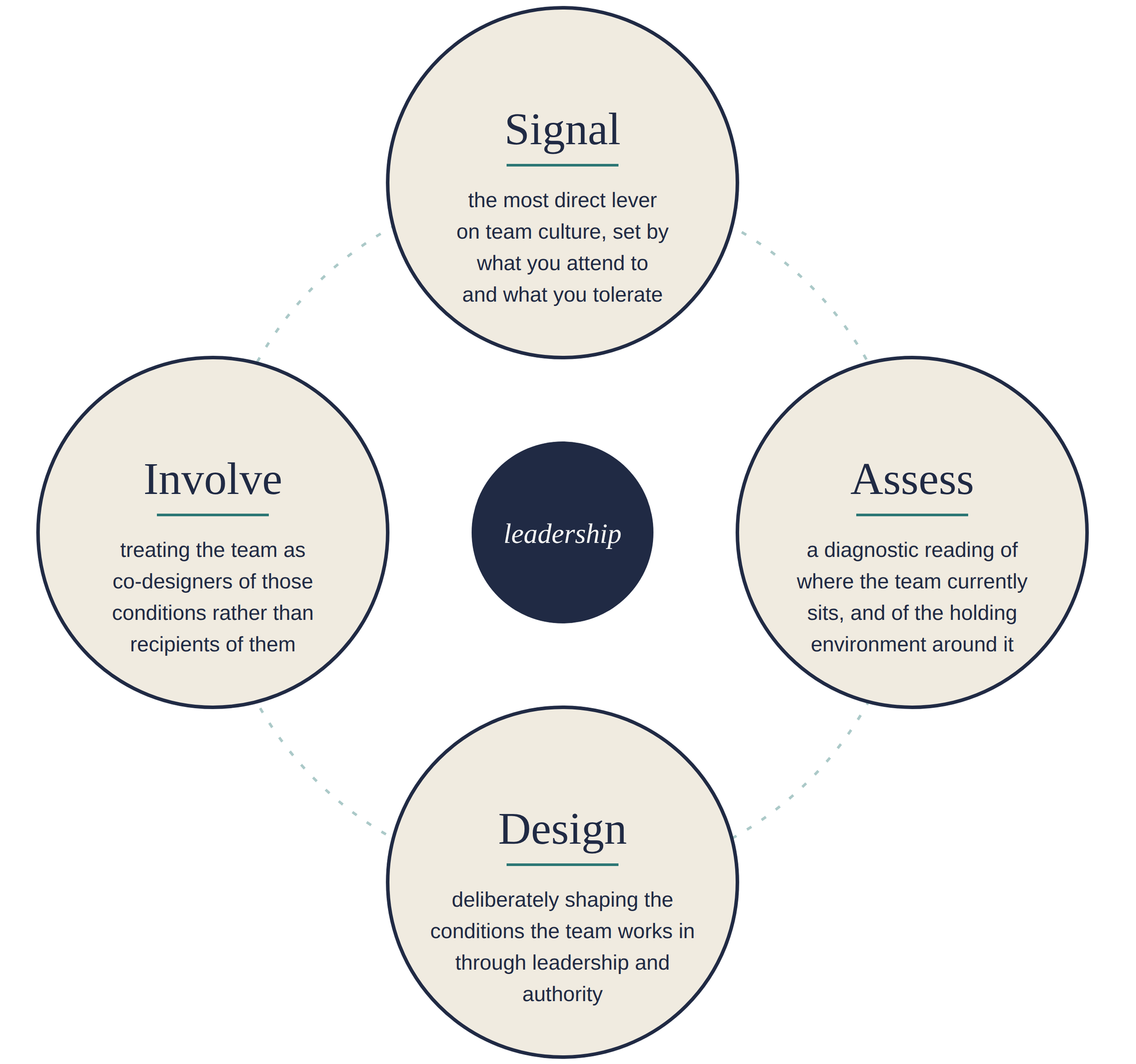
At The Rixe Group, we organise the work of leading through challenging times around four domains we call Signal, Assess, Design and Involve.
Signal is what the leader communicates explicitly through what they pay attention to and what they tolerate. It is the most direct lever on team culture.
Assess is a diagnostic process that involves actively reading where the team currently sits, including the holding environment around them.
Design is the deliberate shaping (through both leadership and authority) of the conditions the team operates in, including protected time and the ground rules that govern how the team talks to itself.
Involve treats the team as co-designers of those conditions rather than recipients of them.
These domains operate concurrently and leaders must engage with them constantly and iteratively.
The diagnostic below is a practical aid for doing this work. Use it to read where your team currently sits and to generate prioritised next moves.
Yerkes-Dodson Continuum
SADI Approach to Adversity
When it's not easy to lead: tackling adversity as a team
When things get hard, what your team produces is more than the sum of how resilient each individual is. The way the team works together drives outcomes that no individual could produce on their own. This matters because resilience under pressure is what allows a team to keep functioning and adapting through disruption, and that disruption has become normal in most workplaces.
Team resilience also feeds team potency: the team's collective confidence that it can succeed. Without that confidence, sustained performance becomes very difficult.
- Team resilience: an emergent state reflecting a team's capacity to manage adversity. Functionally, it is a team's ability to rebound from or adapt to setbacks. Team resilience is not simply the sum of individually resilient people. A team of resilient individuals can still be fragile if shared purpose and mutual trust are absent.
- Team potency: a group's self-confidence in its ability to accomplish tasks and succeed across situations. Team potency is a necessary antecedent to team performance.
- Holding environment: the cultural climate of the team, reflecting psychological safety and shared social capital among team members. The holding environment is the leader's responsibility to build, and the team's responsibility to maintain.
- Heat: the level of pressure or discomfort a team is currently carrying. Some heat is productive and necessary for adaptation. Too much overwhelms; too little leaves the team disengaged.
- Calibration: the act of sensing where the team currently sits on the pressure-performance curve and adjusting from there. Calibration is judgement about what the team needs next.
- Signal, Assess, Design, Involve (S-A-D-I): four concurrent domains for the work of leading through challenging times. Signal is what you communicate through your attention and tolerance. Assess is the active reading of where the team currently sits. Design is the shaping of the conditions the team operates in. Involve is bringing the team into shaping those conditions for themselves.
- Followership (Kelley's typology): a model that maps team members across two dimensions, independent thinking and active engagement. The five resulting types (exemplary, alienated, conformist, pragmatist, passive) help a manager read who to engage first and how.
Use the tabs below to read where your team currently sits and to generate prioritised next moves.